What is a Brand Operating System?
Several years ago I was brought into a Fortune 500 organization to redesign a core digital product. On day one, I asked for the brand assets and the rules that governed them. What I got was a scavenger hunt. Files lived in multiple drives. Logo variations were floating around with conflicting names. Guidelines existed, but they were outdated and interpreted differently depending on the team. I did not just redesign screens, I helped them tighten the brand system so execution could resume without constant friction.
That moment made something obvious. Enterprises do not only lose money from bad design. They lose money from brand chaos. Brand becomes a tax on every team that touches it.
When I started scaling Métisse Studio, I saw the same risk forming early. Métisse is highly visual. It has diverse touchpoints and collaborators across marketing, social, print, web, and production partners. If we kept operating on folders and PDF guidelines, we would recreate the same enterprise problem, just in a smaller room. SoI built what I wish I walked into back then: a Brand OS.
What Brand OS actually solves
Most organizations think they have a “brand system” because they have a deck. The deck is not the system. The system is how quickly a teammate or vendor can find the right asset, apply the right rules, and ship work without needing a meeting.
The cost of not having this is not abstract. Research consistently shows knowledge workers spend meaningful time searching for information instead of doing the work. McKinsey has reported employees spend around 1.8 hours a day searching and gathering information. APQC found knowledge workers spend hours each week looking for or requesting needed information. In marketing specifically, Canto reported many teams waste weeks per year searching for photos, videos, and other files.
Now translate that to brand work: finding the correct logo, the latest template, the approved color values, the current voice rules, the right photography direction for this campaign, the correct version for print versus social. You can feel the burn immediately. Every missing file turns into a Slack thread. Every ambiguous rule turns into a revision cycle. Every revision cycle turns into real money.
Brand OS is designed to remove that tax.
What I built for Métisse
I built a living, searchable library that holds the brand in one place and makes it usable by the people who ship. Not a bloated PDF. Not a folder tree that only the designer understands. A system.
At the center is governed truth: approved assets, approved tokens, approved voice rules. Around it is fast access: a global search bar that gets you to the right file or rule in seconds. And on top of it is role-based delivery: vendors and teams see what they need, not everything.
If you are a print vendor, you do not need social templates and web components. You need print-ready logos, CMYK guidance, high-res photography, and production specs. If you are marketing, you need messaging, campaign assets, approved photography, and copy guidance. If you are social, you need platform-ready formats, caption frameworks, and fast access to the right crops. The point is not “more access.” The point is less noise.
How it was built
Under the hood it is a web app, but the important part is not the tech stack. It is the structure.
I treated brand elements as first-class entities instead of scattered files. Logos are assets with versions, usage notes, and approval status. Colors are tokens with names, values, and rules. Voice is not “a vibe,” it is a set of constraints, examples, and boundaries. Photography is not “a mood board,” it is a curated library with tags, intent, and usage context.
I connected a database to handle metadata and governance and a file management layer to store and deliver the actual assets cleanly. That separation matters because it allows updates without breaking the system. A file can change, a version can be archived, an asset can be replaced, and every collaborator still lands on the correct approved thing.
I also built multiple access points for collaborators and vendors with master admin control. The master admin approves changes, manages versions, and controls who can see what. That governance layer is what keeps the system from decaying into another folder dump six months later.
Feature set
This is what the Brand OS actually includes today:
A global search function that surfaces assets, tokens, rules, and templates instantly.
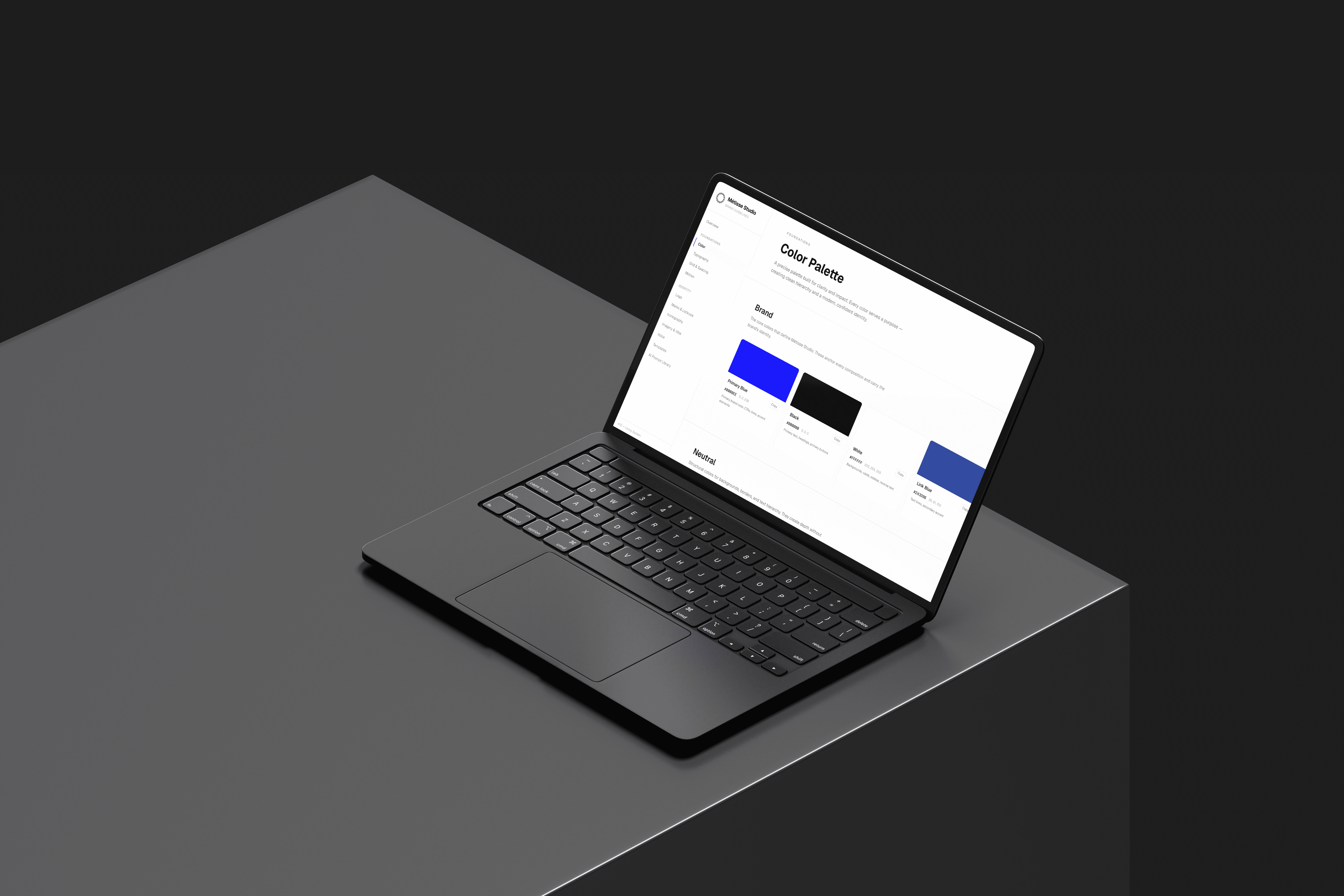
A token library for brand foundations, including copy-ready color values and structured rules.
A versioned asset library for logos, marks, templates, and photography, with approval status so the “right” file is always obvious.
Role-based access views so print, marketing, social, and internal teams each get a focused interface.
A master admin panel that controls updates, approvals, and deprecations so the system stays coherent over time.
Curated photography and visual direction with tagging so collaborators can find assets by intent, not by guessing folder names.
A voice and messaging library with examples and constraints so tone stays consistent across teams.
Prompt libraries that turn brand rules into repeatable generation workflows for copy and creative direction, so outputs stay within guardrails instead of drifting.
Trade-offs and decisions
There were trade-offs we accepted deliberately.
I chose operational clarity over decorative UI. If the system is beautiful but slow, it fails. If it is clear and fast, people use it.
I chose governance over “everyone can edit everything.” The fastest way to destroy a brand system is to let every stakeholder upload their own versions without approvals. So we built master admin control and approval states.
I chose search and structure over “just make a folder.” Folders work until the first real growth moment. Then they collapse under ambiguity.
I also chose to ship a working OS before chasing advanced features. Things like automatic tagging, semantic search, or deeper automation can come later. The first win is eliminating friction.
Results
This is what it has enabled for Métisse in practice.
We onboard collaborators with far less overhead. Instead of sending a pile of links, explaining where things live, and policing usage, we share one system. Onboarding time has dropped by more than 60 percent.
We cut production waste. Fewer wrong files. Fewer “is this the latest?” conversations. Fewer revisions caused by misalignment. Based on the time we no longer spend chasing assets, recreating work, and correcting drift, we estimate the system saves roughly $30,000 to $50,000 annually in avoidable production inefficiency.
We reduced collaborative production costs by roughly 20 percent because contributors start aligned. When the rules and assets are obvious, collaboration becomes execution instead of negotiation.
And the soft result is the one you feel every day: less friction, less second-guessing, less chaos. The brand becomes easier to maintain as it grows, not harder.
Why this matters more as you grow
The larger the organization, the more brand touches exist. The more touches exist, the more “small” mistakes multiply into real costs. Brand OS is designed for that reality. It acknowledges that brand lives in the hands of marketers, sales teams, social managers, print vendors, event coordinators, developers, and partners. Most of them will never open a design file. They should not have to.
This is the shift: stop treating brand as a deliverable. Start treating it as infrastructure.